Showing posts with label Catherine Allen. Show all posts

Thursday, December 15, 2011

Lottie Moon, SBC's most heroic figure


Because of the offering in her name, Charlotte Digges Moon, Lottie Moon to all of us, is the SBC's most heroic figure.

If SBCers would take an excursion away from the usual Christmastime abstract of her life found in International Mission Board materials and repeated in church Lottie Moon Christmas Offering promotional stuff and read her biography, they would probably join me in my assessment.

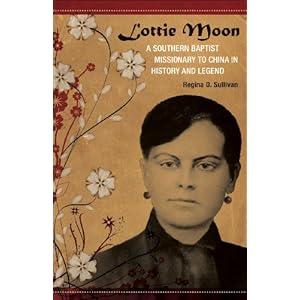
Regina Sullivan wrote the latest biography of LM (cover image is shown here). A previous biography, 1980, was written by Catherine Allen. I bought the former and was generously sent a copy of the latter by Wanda Lee, WMU president. I read Sullivan's but haven't had time to read Allen's.

Moon was an inspiring example, serving in China. Pioneering work, alone, in some parts of the interior. Living through the Boxer Rebellion. Vigorously contenting for the faith, pleading for support. Read the book.

One of the popular blog sites interviews prominent SBCers and always asks them who some of their heroes are. I think my memory is correct when I say that Lottie's name has yet to be mentioned. The current SBC is manifestly gender-sensitive, a euphemistic way of putting it. Serious gender issues are meant to be subsumed under the sterile vocabulary of "complementarianism" and "egalitarianism" issues for another day on my blog.

I wouldn't have any hesitation in naming Lottie Moon as one of my heroes in Christian ministry.

One side note. Why the IMB continues to use the unattractive "schoolgirl" photograph of jut-jawed Lottie in their promotional materials is beyond me. , Regina Sullivan told me that she saw a letter from LM to the board asking that they not use that photograph. There are certainly others available. You would think that they would use a photo of Lottie from her time in the field. The "schoolgirl" photo is almost certainly prior to her time in China.

I'm praying that the LMCO shows an increase this year.

Friday, August 19, 2011

WMU on the new Lottie Moon book


I asked the WMU in Birmingham a couple of questions about the new Lottie Moon book by Regina Sullivan, you know, the book that labels Lottie's death story a "myth".

On the picture of LM above. The WMU archivist dates it at 1877. I had some question about its authenticity but I'm satisfied with that. So, how about we archive the jut-jawed, Lottie Moon schoolgirl photo shown below in favor of this picture.


Let's let Lottie be a grown-up and not a schoolgirl.

I also asked for comment on the death "myth" and Wanda Lee, WMU president, said they were confident in the story as related by Catherine Allen in her 1980 biography of Lottie Moon. Further comment to come later, I would guess.

Any way you slice it or picture it, Lottie Moon's story is an inspiring one.


Tuesday, August 2, 2011

Time to drop the Lottie Moon starvation myth?

The use of Moon’s death as a means to shame Southern Baptists for their financial neglect of the Foreign Mission Board proved effective in the latter half of the twentieth century as it had been in the early decades.
This is Regina Sullivan’s conclusion in her new book on Lottie Moon. What that sentence doesn’t say is that the common account of Moon’s death, that she stopped eating as a protest to the FMB’s inability or reluctance to help with Chinese famine relief and in order to send all of her own money to those Chinese who were suffering, belongs in the realm of myth and legend, not fact.

Sullivan reviews Moon’s death along with the reactions to it and traces the story of the sacrificial death myth. She attributes it to Cynthia Miller, the missionary nurse who was accompanying Moon on her journey home and who was with her when she died in Kobe, Japan harbor on Christmas Eve, 1912. Later in that journey from Japan to the states, Miller met with one of Moon’s friends, Jennie Snead Hatcher, in Honolulu. Based on her conversation with Miller, Hatcher wrote a full-page remembrance of Moon that was published in the Virginia Baptist newspaper. That remembrance was a sacrificial death narrative coupled with an emotional fund-raising appeal.

Hatcher wrote of Moon, that...
...after months of heroic exertion and unexampled self-sacrifice, she broke down and sank into a melancholy state, refusing food that the hungry might be fed. The indebtedness of the [Foreign Mission] Board also preyed upon her mind until the very last.
It's not difficult to go from there to statements such as this one from the "Lottie Moon is Starving Again" promotional theme of the 1988 Lottie Moon Offering:
Lottie Moon literally starved to death...So she gave all she had to give from her food to her last ounce of strength.
Well, not true, but what a tale.

The facts of Moon’s death included a refusal to take solid food, a wild, demented, and irrational concern for her own money and that of the FMB, depression, and a rather severe and deep boil behind her ear on her neck that was thought to have affected her mental and physical condition. She became sick, rapidly declined, and died at 72 - a tragedy and great loss to the missionary work in China.

Evidence against the starving-herself-to-death narrative are contemporary accounts from her missionary colleagues who did not note such things, the fact that she died with plenty of money in the bank and had lived with FMB money problems for decades, obituaries which didn’t so explain her death, and, most notably, errors passed along from the nurse to Moon’s friend Hatcher.

We Baptists, back then and today, are certainly pragmatists. We know and like something that works, especially if it brings in the shekels. If the facts don’t quite support the story, well, we are loath to give up such an effective story. What’s the harm in a little legend if it helps the flow of money for good causes?

Sullivan writes that Moon’s biographer, Catherine Allen, was faced with those who wanted the myth corrected in her new book but also those who “advised her not to ‘tamper with the precious story.’” Allen decided to leave the implication of the death narrative myth intact, while not directly stating it. Like I said, we like a good fund raising story and hate to give it up.

It’s time to give this one up.

Lottie Moon’s 39 years on the mission field is far more significant, much more thrilling, and vastly more inspiring than the events of the last few months of her life.

Monday, August 1, 2011

The old, old story: Lottie Moon and Crawford Toy

I was introduced to the story of Lottie Moon and Crawford H. Toy at one of the SBC annual meetings during the contentious years of the Conservative Resurgence. During that time, one of the marquee conservative preachers (Criswell?) told the story of our beloved Baptist saint and revered icon and her romance but ultimate break with the brilliant, but liberal Southern Seminary professor Toy.

The narrative went like this: Pioneering SBC single missionary, Lottie Moon, was in love with the learned professor Crawford H. Toy. Marriage was planned and the couple planned to serve on distant oriental mission fields. Toy, though, migrated to more distant and foreign theological fields, those of higher biblical criticism and Darwinism. When Lottie learned of this she broke off the relationship, returned to China, and continued until her death the work for which she is known, remembered, and revered. Toy continued down the path of liberalism eventually leaving the SBC and even orthodox Christianity.

The lesson for SBC conservatives in the 1980s was plain - Lottie Moon recognized liberalism and fled from it a century before SBC conservatives recognized it.

So, is this part of Conservative Resurgence mythology? Did conservatives dredge up this obscure part of Lottie Moon's life and dramatize it to their advantage? Or, is it factual?

Much of the story is not in dispute: Lottie Moon and Crawford Toy were engaged to be married. They did not marry. Moon did serve out her life on the mission fields of China. Toy was indeed a brilliant scholar but one whose views became more and more liberal. He died a Unitarian.

A lengthy article by Dan Kent in 2003 says of Lottie's break with Toy: “Eventually, she began to hear of the [Toy] controversy. "She obtained books which were representative of Toy's position which she studied. She became violently opposed to his views, broke off the engagement, and never married." (47) "Toy's family understood that there was an engagement which was broken because of religious differences." (48)

Kent relies on Pope A. Duncan ("Crawford Howell Toy: Heresy at Louisville," in American Religious Heretics: Formal and Informal Trials, 1966) for the first part of that paragraph and Catherine B. Allen’s 1980 WMU biography of Moon for the second. I can't determine excactly where Kent got that Lottie "violently" reacted to Toy's views.

Concerning the relationship and cancelled wedding plans, Regina Sullivan in her new book on Lottie Moon ("Lottie Moon") conducts a more exhaustive examination of the source materials. The Moon/Toy relationship takes up only three pages and Sullivan concludes that evidence is lacking and the reason is unclear why the marriage never occurred. She notes that there are no letters between Toy and Moon extant and that there is a gap in correspondence between Moon and Foreign Mission Board head H. A. Tupper for a critical time when marriage was planned but Moon was in China and Toy stateside. If she "violently" opposed Toy's views, that description must have come from secondary sources. We have nothing from Lottie herself on this.

It is quite clear from Sullivan's research that Moon maintained her relationship with Toy for years after his forced resignation from Southern seminary and during the period when Toy's views were hotly criticized in the Baptist papers. What was Lottie writing to her fiance during this time? We don't know and probably never will.

Sullivan offers two possibilities for the cancelled wedding.

“The first is that Moon realized that if she married Toy her career as a missionary would be over” Toy being unacceptable to the Foreign Mission Board because of his views. The second is that “Toy’s views had finally moved too far from what Moon considered orthodox, causing her to reconsider the marriage.”

Since both of these pivot on Crawford Toy’s theology, I don’t see how the CR narrative needs much adjusting other than to drop the references to Moon's emotions. If it looked like his theology was such that he anticipated appointment by the FMB, he and Moon might have married and both served in China or Japan. If he had not gone as far theologically as he did by the early 1880s, perhaps he would have remained acceptable to Moon and they could have married.

Sullivan says that Moon's later actions "suggest that she allowed some variance in doctrinal matters." She bases this primarily on Moon's intercession with FMB head Tupper in behalf of a missionary colleague who resigned over theological questions. Moon wrote and asked Tupper not to accept the resignation and allow the missionary time to think about and work out the unspecified theological issues.

Interesting, but not compelling.

So, how can the Moon/Toy narrative be truthfully told?

While we don't know and cannot say exactly what Lottie was thinking, the evidence points to the accuracy of the standard narrative: Moon and Toy were to be married. They did not marry either directly because of Toy's liberalism or indirectly because his views made him unacceptable for missionary appointment. Moon goes on to become a Southern Baptist saint. Toy has a distinguished career at Harvard but dies outside of orthodox Christianity.

Moon's journey continued in faithfulness and for the faith once delivered to the saints. Toy journeyed away from the same and died outside orthodox Christian faith.

Let the reader judge which path was superior.
____________

Read Al Mohler on Toy with links for the Toy/Moon matter: Heresy is not heroic which has a link to Kent's article.

Previous discussion by plodders like me may be found: here.